
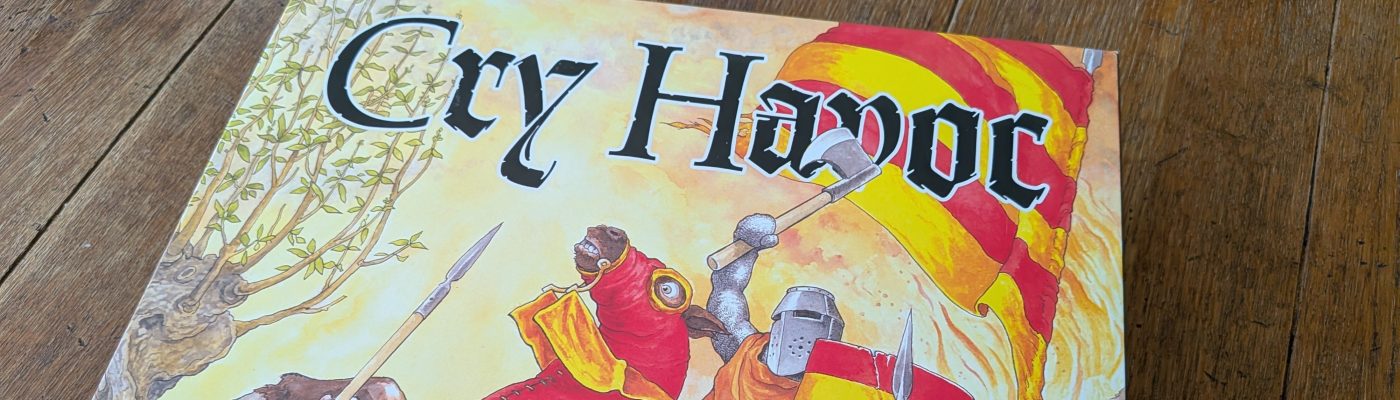
Originally published in 1981, Cry Havoc is a board game of man-to-man combat in medieval Europe. Supported with four official expansions, the game has been kept alive by dedicated fans over the decades through the unofficial Cry Havoc Fan. Now, with a recent Footsore Miniatures & Games Kickstarter, the game made a triumphant return to the table. Cry Havoc has been remastered and retooled – all with all-new artwork from the original artist, the legendary Gary Chalk. Although before my time, I was excited to pick up a copy. I’ve played a few games and feel like I can share my thoughts on this classic wargame. Has Cry Havoc aged like a fine wine? Or should it have been left on the shelf collecting dust?
The Components
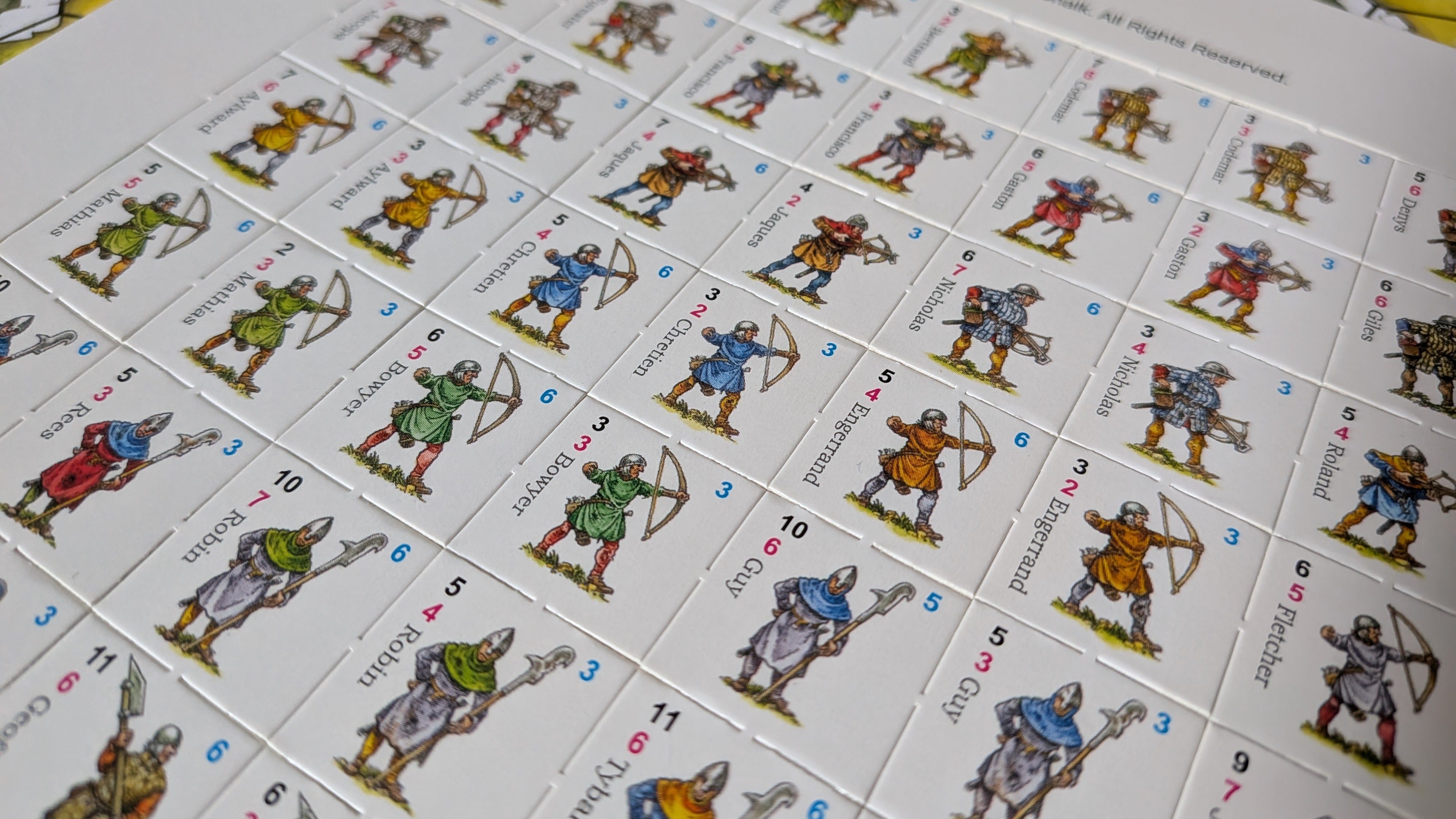
The unit tokens. Great artwork, terrible token quality.
Let’s start with the bad, shall we? The component quality is … rough. The game is played on large, foldout mats. Unfortunately, the mats are thin and have a deep crease down the middle where they are folded to fit into the box. They bend and warp, and I don’t think they will survive a full campaign. The unit tokens (pictured above) are printed on thin cardstock and need to be punched out. FFG-quality, these are not. The tokens are thin, flimsy, and just don’t feel like a quality game piece. With the amount of moving, flipping, swapping, and stacking of units that takes place during gameplay, I would be shocked if these tokens make it through even a dozen games. That being said, the artwork is fantastic. Gary Chalk redid the art for the maps and the unit tokens, and it’s lovely. Full of character, detail, and vibrantly colored. I just wish they were printed on higher quality materials. I was shocked when I opened the box and felt how thin everything was. Even the Rulebook and Play Sheets use super thin paper. Everything about the production feels, and I hate to say it, cheap. It all looks great. Truly. But it doesn’t feel great in hand, and that’s a real disappointment.
The Rules
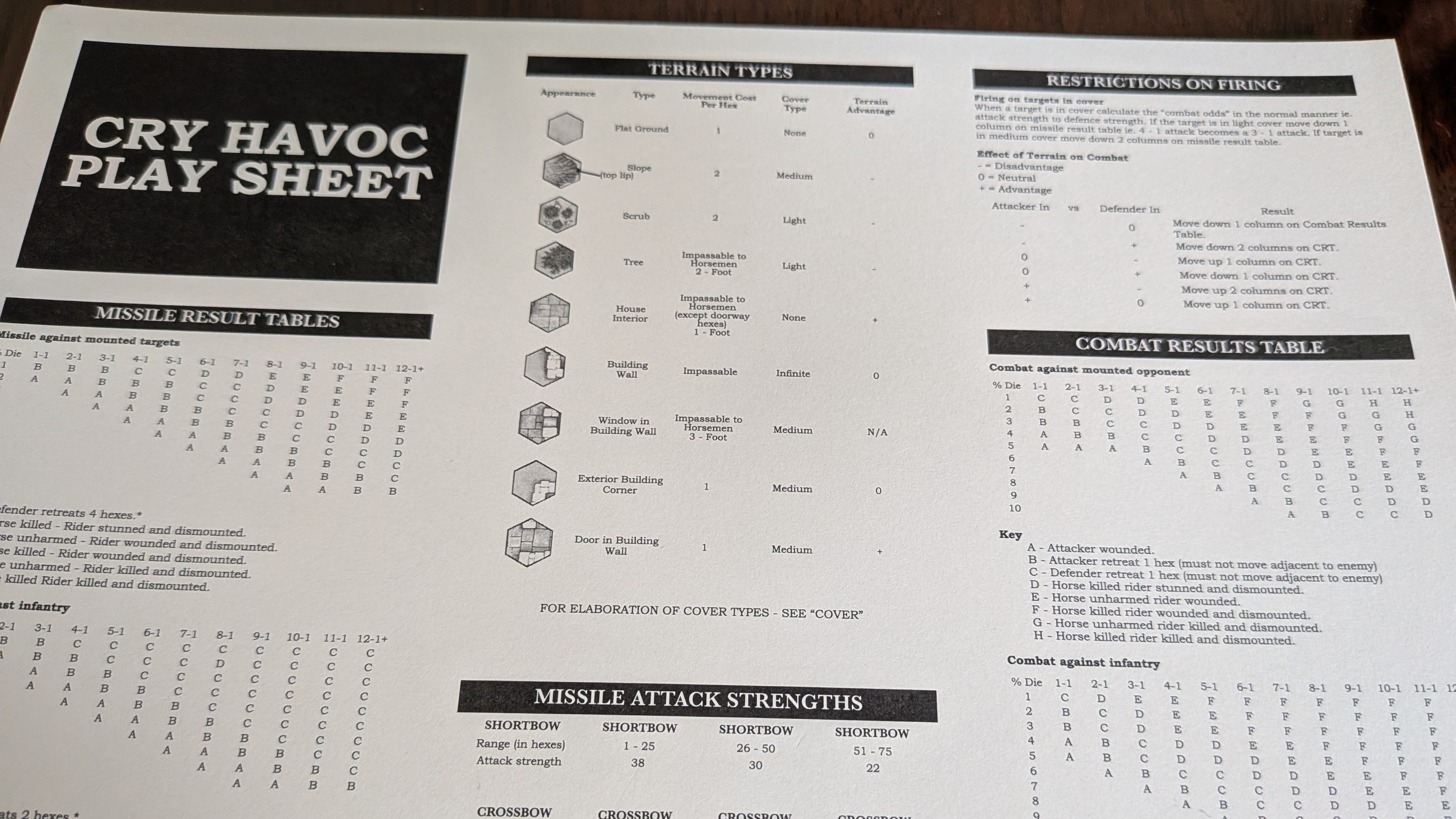
The Play Sheet is meant to serve as a quick reference guide. Sadly, there is nothing quick about referencing this half-page printout.
The rules are old school. Very old school. The system of comparing attack to defense is tried and true. However, there is far more math involved than I would like. For both shooting and melee, you need to calculate the Combat Odds. This is done by dividing the Attack Strength by the Defense Strength, rounding down – an Attack Strength of 8 versus a Defense Strength of 3 would be Combat Odds of 2-1. Now, find the 2-1 column on the Combat or Missile Results Table and roll a single d10. Depending on your roll, the result could be anything from the defending soldier being killed, wounded, stunned, or forced to retreat. There is also a chance the attacker themselves will be wounded or forced back. It’s not a bad system, but doing the mental math to find the simplified ratio of 32:7 in the heat of battle is, for me, a big ask. This is not adding or subtracting To Hit modifiers; this is fractions! An order of magnitude more difficult. Once you add in multiple combatants and terrain modifiers, the game really starts to bog down. Even John, who has phenomenal mental math skills, was starting to suffer from the cognitive load.
The combat system may not be fluid; it’s clunky, requiring multiple starts, stops, and table references, but it works. Combat and shooting are both frighteningly deadly. Shortbows and Crossbows fired against lightly armored troops are almost guaranteed to kill the target outright – an outcome that is far less common in melee. When fighting in close combat, more often than not the attackers and defenders are locked in stalemate. That is until one side manages to trap or corner their opposition. If you are forced to retreat but do not have space, you are wounded instead. And once wounded, it’s only a matter of time before you are killed. The importance of positioning and supporting friendly troops with their allies all makes intuitive sense. The Combat Odds mechanic works thematically as well. An armored knight on a warhorse will easily overpower and kill just about anyone on foot. It takes at least three infantry attacking together to bring down a mounted knight. Again, that makes sense. No issues there. It’s the constant calculation of odds and checking of tables that slows everything down.
With more play experience, it’s possible that everything will become more fluid. But the Rulebook itself is a mess. Specific rules are scattered all over the place. Rules are split between the Rulebook and the Play Sheets (shown above) with no easy way to search for rules. The Play Sheet is meant to serve as a quick reference and/or rules overview, but it’s printed on a half-sheet of paper in what looks like 8pt font, and it’s a real struggle to read. There is nothing “quick” about referencing the Combat Results Table – with no ruling or lines, you have to be very precise with how you read the table. Now, from what I can tell, both the Rulebook and the Play Sheet are faithful recreations of the originals from 1981. This is not a “remaster” or a “remake”, it’s a “reprint” with new artwork. I get that. But why not take the time to reorganize your rules? Can we at least correct the typos in the Rulebook? Calling out small errors like that is low-hanging fruit, sure. But the gameplay is not complicated. It shouldn’t be this difficult to find the answer to a rules question.
So the rules have some issues. But we don’t judge a game after only reading the rules; you gotta get it out on the table! How does Cry Havoc play?
The Gameplay

The peasant levy face down a charge by armored knights with expected results.
Despite the archaic mechanics and rules writing, the moment-to-moment gameplay is solid. Players alternate turns with Player 1 completing all of their actions – Shooting, movement, melee – before Player 2 takes their turn. As there are no “reactions” or counters, it really is a back and forth between the active player and the passive player. Combat is not an opposed roll, there are no saves or anything like that. When it’s not your turn, you are along for the ride. All you can do is watch your opponent move their troops into position and wait for the attack rolls to start coming in. We found it was most efficient for the passive player to have the Combat Results Table on hand to read off the results of each attack.
Each individual soldier has a name and pair of corresponding tokens. I bring this up because each soldier will begin the game unharmed with their full strength counter on the board. If a soldier suffers a stunned result, simply flip over their token to the stunned side. If they are wounded, replace their starting token with the wounded one (slower movement, less attack and defense). If they are killed, flip the wounded token over to show the dead side. It’s a simple and elegant solution for keeping track of everyone’s status. However, because the tokens are not separated into factions or teams, you must keep them all facing the correct way – towards the controlling player – or else you will lose track almost instantly of who controls who. It also would have been a nice touch to have the dead counters printed with a different background color, like a light grey. The game board can quickly fill up with dead soldier tokens, and it makes it hard to scan for which of your troops is still alive.
There are optional rules for tracking ammo count as well as Command & Control. I cannot imagine the headache tracking ammo would cause. I don’t think this game needs that level of granularity. I am interested in trying out the rules for Command & Control, but they also require extra bookkeeping as you note which soldiers are under each specific Sergeant’s command. Using a more general area of command would be much easier to track. These are not optional rules that I recommend for your first few games.
With the extra mats added in the Kickstarter, we have the option of lining up three or four connected areas to create a huge battlefield for a truly massive clash. But I shudder to think of how long it would take to play. Maybe as a 2v2? Or even a four-player free-for-all. Now that is an idea worth exploring.
Final Thoughts

Unlike other classic game reprints, I have no nostalgia for Cry Havoc. Make no mistake, this is very much the type of game I would have loved to play when I was a kid, but I never had the chance. I only say that to make it clear that my thoughts are not clouded by nostalgia. That would not be the case if we were taking a look at something like Warhammer Quest or Axis & Allies.
Despite all my issues and misgivings, the game is fun. Really fun. It lends itself to wild and cinematic moments. All of the soldiers have names, and there is nothing like watching the poor, humble Robin armed with a glorified farming tool take down Sir Roger with a lucky strike and some help from his fellow peasants. Shaking your head in disgust as the noble Sir Richard again fails to deal damage on a foe wearing nothing but cloth never gets old. The lopsided nature of Medieval combat makes each fight a serious risk, and survival is far, far from guaranteed.
At the risk of repeating myself, the game is fun to play. But this 2026 version was a missed opportunity. There was a chance to improve the component quality and rewrite the rules with modern design in mind. Some extra time spent refining the final product would have gone a long way.
All of my issues are quality-of-life improvements, component enhancements, and opportunities to streamline the rules. It’s such a disappointment because the game is good. It’s clearly a beloved classic for a reason. My biggest problem is the game makes you work for that enjoyment. It’s hard to play not because it’s complicated or overwrought. Quite the opposite. The game is simple. It’s just one that was written and produced in the 1980s.
At the end of the day, it all comes down to one question: would you want to play Cry Havoc again? Yes. I cannot wait to play again.

