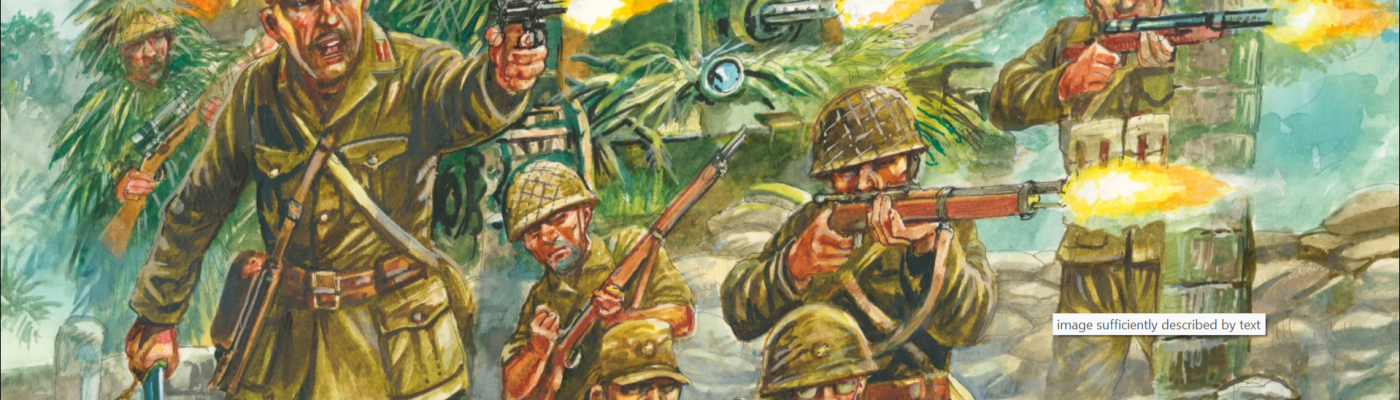
Just shy of one year after we published the Armies of Germany: Third Edition review, the fifth and final book for the “Big Five” has landed. Armies of Imperial Japan: Third Edition is the last, but certainly not least, core Armies of published for Third Edition and it’s finally time to see if the fundamental difference in Imperial Japanese combat doctrine and military tactics translates into Bolt Action. The Japanese have always had a unique playstyle and access to unit options unlike anything other nations can put on the table. Does the Third Edition book still capture these differences? Let’s dive in and find out!
What’s in the book?
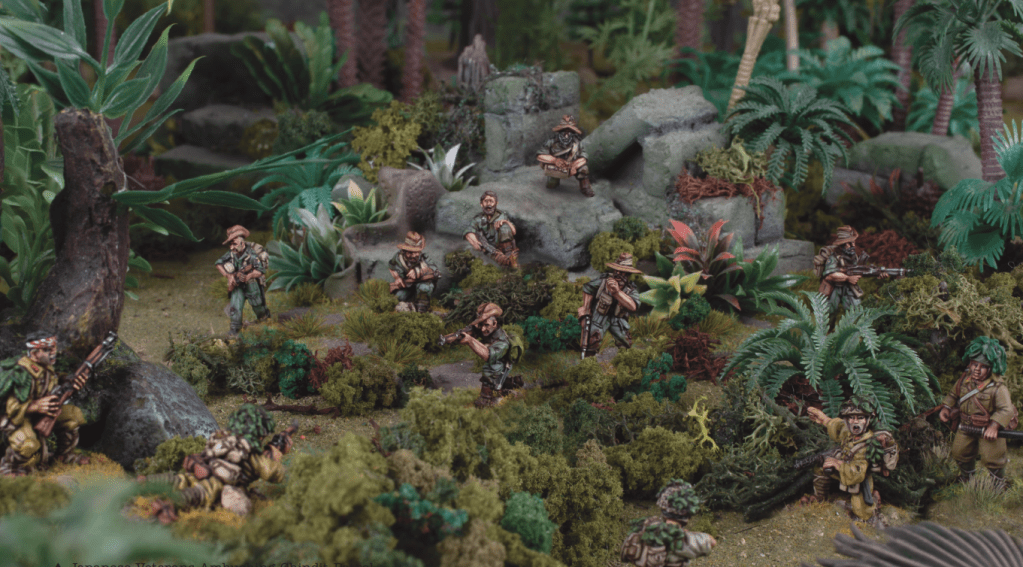
At 96 pages, Armies of Imperial Japan is the slimmest Third Edition Armies of book (as it was in First Edition). For context, Armies of the Soviet Union, United States, and Great Britain are all 112 pages, while Armies of Germany is 16 pages longer at 128. But don’t let this discrepancy impact your opinion. Armies of Imperial Japan is packed to the brim with fantastic and truly unique Army Special Rules and unit options.
As with the other Armies of books, AoIJ is divided into five sections. It begins with a historical overview of The Armed Forces of Imperial Japan World War II, followed by an introduction to the Forces of Imperial Japan in Bolt Action. Then we get to the main event; The Army List, Sample Armies, and Force Selection Guides.
I. The Armed Forces of Imperial Japan in World War II
Although not as vast as The Soviet Armed Forces in World War II in AoSU, The Armed Forces of Imperial Japan in World War II is a more detailed and interesting read than the sections included in AoUS and AoGB. The section starts in 1904 with the Russo-Japanese War and carries on through 1945. The specific focus on WWII beginning in The East with the Japanese invasion of Manchuria in 1931 is a welcome change to the European-focused narrative of the war starting on Sept. 3, 1939.
II. Forces of Imperial Japan in Bolt Action
Divided into five sections covering the Imperial Japanese Army, Special Naval Landing Forces (SNLF), Paratroopers, Veteran Jungle Fighters, and Home Defense Troops, Forces of Imperial Japan in Bolt Action gives players a high-level look at each of these distinct military branches. With the exception of the Imperial Japanese Army, each of these branches is provided with special rules for Yamato Damashii, so it was no surprise to see some historical background and modeling direction. The background is light, about half a page for each, but for folks new to the game, this chapter provides an excellent primer on each Yamato Damashii option.
III. The Army List
Army Special Rules – The Imperial Japanese have four Army Special Rules:
- Death Before Dishonor – Gyokusai
- Banzai!
- Lack of Radios
- Yamato Damashii
- SNLF
- Paratroopers
- Veteran Jungle Fighters
- Home Defense
Death Before Dishonor is the same its always been. No changes since First Edition. Every Infantry and Artillery unit in the Imperial Japanese force has Fanatics. This Army Special Rule enables Japan to play in a fundamentally different manner than other nations. Your troops won’t break from Pins and will fight to the last man in close quarters. The overall effectiveness of assaulting in close quarters took a hit in Third Edition, but if you want to focus on CQ, Imperial Japan does it better than anyone.
Unlike Death Before Dishonor, Banzai! has changed significantly from its previous iteration. Banzai! is no longer an “always on” Army Special Rule. It’s now a tool in the toolbox, something that must be considered before use and can only be applied in specific situations. In the same manner as “You Men Snap To Action”, a Japanese Officer (PC or CC) can issue a Banzai! order. If successful, all Infantry units within 6″ of the PC/CC that have not already been issued an order that turn are issued a Run order. All affected units, including the initiating Officer, must then attempt to engage the closest visible enemy in close quarters. Every unit that receives a Run order from a Banzai! will execute that Run automatically, regardless of Pins; no Order Test is needed.
Ok – lots to unpack here. At first glance, this is a powerful “break glass in case of emergency” option for any IJA commander. Anything that lets you move up the board while ignoring Pins is best not underestimated. However, there are some big questions regarding the practical implications for how Banzai! is actually executed. First and foremost, what do you do if there is no visible enemy unit? Do the units not move? Do they run in a random direction? Does it count as a “failed charge” and you still move the full Run distance towards a non-visible enemy? Or if there is no visible enemy unit, are you not allowed to Banzai!? A Day 1 FAQ is required for Banzai!
Outstanding questions aside, I love this rule. The previous version of Banzai! was too easy to manipulate and never really felt right. But this version feels far more dramatic and thematic. The idea of an Officer leading from the front, issuing a desperate charge in the final moments of a game in order to throw units into combat over an objective is what Bolt Action is all about. It just needs some clarification.
Lack of Radios was introduced in AoSU, and Imperial Japan now has the same Army Special Rule. It’s a thematic option that can save you a few points in your Armored Platoon if you are not worried about a larger +1 Morale bubble.
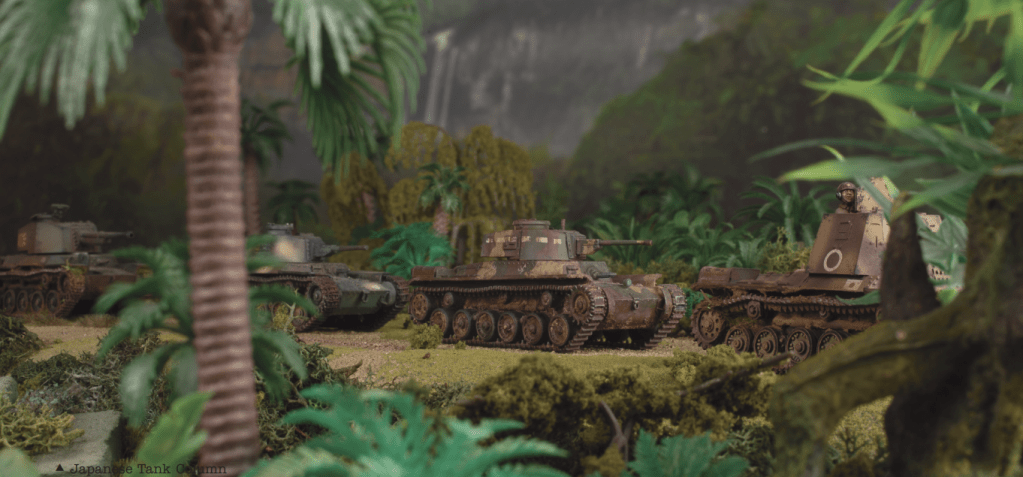
Yamato Damashii is the Imperial Japanese version of the German Defend the Fatherland!, the American By Air, Land, and Sea, the British For King and Country, and the Soviet Hammer and Sickle. The options are:
- SNLF have two special rules:
- Bitter Rivalry – SNLF PCs reduce their cost by 5pts and SNLF CCs reduce their cost by 10pts. Their “You Men Snap to Action” ability (including Banzai!) only affects other SNLF units.
- If taken as Veteran, they must be given Iron Discipline for +1pt per model.
- Iron Discipline – Units remove 2 Pins instead of 1 when they pass an Order Test.
- Paratroopers
- Units must be Veteran.
- Units must be given Tough Fighters for +1pt per model. SMGs are discounted to +3pts.
- Any Infantry unit (except for MMGs and Medium/Heavy Mortars) may take Bicycles for +1pt per model.
- Veteran Jungle Fighters – Units must be taken as Veteran and must be given these rules for +3pts per model:
- Behind Enemy Lines
- Ambush Tactics – When deployed on the table, these units may start the game on Ambush.
- Fieldcraft (also applies to Light Howitzers and Light AT Guns, but not other artillery units)
- Home Defense – Must be taken as Inexp. (except for Officers who can be Inexp. or Reg).
- Inexp. units are both Green and Unpredictable for free.
- Green – The first time the unit takes a casualty, roll a d6:
- 1: The unit immediately goes Down and suffers an additional d6 Pins.
- 2-5: The units fights on as normal.
- 6: The unit is immediately up-rated to Regular with a Morale of 9 for the rest of the battle.
- Unpredictable – Anytime a Home Defense unit fails an Order Test, roll a d6:
- 1-2: The unit immediately goes Down and takes d3 Pins.
- 3-4: The unit immediately goes Down as normal.
- 5-6: The unit immediately makes a Run order towards the nearest visible enemy unit. If the move would bring them into contact with that unit, it counts as an assault into close quarters.
- Green – The first time the unit takes a casualty, roll a d6:
- Inexp. units are both Green and Unpredictable for free.
Fantastic. AoIJ has delivered on the Army Special Rules front. You’ve got plenty of options with Yamato Damashii and both Death Before Dishonor and Banzai! offer a truly unique playstyle unlike any of the other Big Five. Breaking it down further:
Paratroopers are Tough Fighters. This is a departure from the Stubborn all other Airborne have. For Germany, the United States, Great Britain, and the Soviet Union; their Airborne are Stubborn. That’s it. Not so for the IJA and IJN. Their Paratroopers are already Fanatics (a buffed version of Stubborn), and they get to be Tough Fighters as well. Squads of Vet Tough Fighters are scary. Squads of Vet Fanatic Tough Fighters are terrifying.
SNLF was a surprise. Not that the option existed, but the addition of Iron Discipline rockets the SNLF to S-Tier powerful. Additionally, unlike British Guards, who can only have the Guards option on two Infantry Squads, the Japanese can slap SNLF onto four different Squads (SNLF Squad, Grenadiers, Paratroopers, and Engineers). The SNLF have arrived and are looking strong.
Veteran Jungle Fighters are Chindits, and Chindits are Veteran Jungle Fighters. Same rules. Same cost. I’ll copy over my thoughts from the Armies of Great Britain: Third Edition review:
And finally we have Chindits at +3pts per model. Getting Fieldcraft is amazing. Getting Fieldcraft on your Light Howitzers and AT Guns is even more amazing. BEL is … fine. Ambush Tactics is really interesting, but there are no rules to ensure your Chindits will get to deploy at the start of the game. We also have the frustrating combo of BEL + Ambush Tactics. If my unit has Behind Enemy Lines, I want them in Outflank. If my unit has Ambush Tactics, I want them deployed. Having both rules on the same unit is annoying. Getting the choice would have been a nice adjustment. Then you could deploy the units with Ambush Tactics and keep other with BEL back in Outflank.
Home Defense is a welcome addition. Bolt Action has always been filled with “what if” forces, and Home Defense opens the door for a defense of the Home Islands “what if” platoon. The combination of Green + Unpredictable makes for both an interesting and difficult-to-manage combo. Command & Control will not be easy, but you do have the chance for some very cheap Regs to suddenly appear as your Inexp. Home Defense troops “level up”. I reckon the Battle Flag and Kempeitai Officer are must-haves for anyone running Home Defense units.
I’m impressed with these options. The only critique I can come up with is the Mid/Late-War lean for these Army Special Rules. The Japanese had been fighting in mainland Asia since 1931, and these rules don’t really reflect the first 10+ years of Imperial Japan at war. The flavor is more suited for the desperate island defenses of 1943-44. It’s a minor quibble and one that is sure to be addressed once Armies of China is released (there is no indication this will happen).
Quartermaster’s Stores – Specialized equipment and rules for the Japanese include:
- Shin Gunto
- Type 89 Grenade Launcher
- Battle Flag
- Signaling Bugle
- Demolition Charges
Starting with the Shin Gunto (‘new army sword’), this piece of equipment updates the rules for models armed with a sword. Not only does Shin Gunto grant Tough Fighters, if the model already has Tough Fighters, they roll an additional die in close combat. That’s two re-rollable attacks! From my reading, this would be:
- Officers and Forward Observers with Yamato Damashii (Paratroopers)
- IJA and SNLF Paratrooper Squad NCOs
- Japanese/Manchukuoan Cavalry Squad NCOs
- Sennyuu Infiltration Team NCOs
- IJA Engineers NCOs with Yamato Damashii (Paratroopers)
You may not have the option for full squads of sword-wielding Tough Fighters, but an extra attack here and there could swing the combat in your favor. Keep in mind, everyone is Fanatic so that Shin Gunto-armed NCO is going to keep on swinging until they are the last man standing.
The Light Mortar is dead. Long live the Type 89 Grenade Launcher. Your Grenadier Squads can bring up to three Type 89s per unit at +25pts each. The Type 89 follows the same rules as Light Mortars with one significant change: Low-angle Fire. The minimum range is a minuscule 6″, giving you the ability to blast away with volley after volley of 1″ HE templates as you (or the enemy) closes the distance. These Type 89s also have the Targeting special rule, so they must fire at the same target unit. However, they may split fire from the non-Type 89 armed models in the squad.
The Battle Flag is similar to the Soviet Victory Banner. Not only does the Battle Flag provide +1 Morale to all friendly Infantry and Artillery within 12″ and LoS, but it also protects your units from the Rookie Pilot roll on the Air Strike chart. But, unlike the Victory Banner, the Battle Flag can only be purchased by an Officer; so limited deployment options, but still something that most players should consider bringing.
The Signaling Bugle is another area of effect option for Imperial Japan, and I believe it’s the only equipment that hits the enemy with a debuff in all of Bolt Action. All enemy Inexperienced Infantry and Artillery within 36″ suffer -1 Morale if they do not have LoS to the model with the Signaling Bugle. At the bargain basement price of 10pts, that is pretty much an auto-include. I’m also loving the Battle Flag + Signaling Bugle combo; Bolt Action needs more AoE equipment.
The final piece of equipment is the Demolition Charges, and they are the same for Japan as everyone else. There is only one unit with the option to bring them – the IJA Engineer Squad. Interesting that the Pioneers do not have the option (not that Demo Charges see much play).
As with the Soviets, the Quartermaster’s Stores really came through for Imperial Japan. These additions make a significant impact on the overall feel of the force.
The Units
The strength at the disposal of anyone taking up command of an Imperial Japanese force is all contained in The Army List:
- HQ – 4 unit entries (4 Soviet Union / 4 Great Britain / 4 United States / 4 Germany)
- Infantry Squads & Teams – 25 unit entries (30 / 20 / 28 / 45)
- Artillery – 12 unit entries (14 / 10 / 12 / 17)
- Vehicles
- Tanks/SPGs – 19 unit entries (31 / 43 / 47 / 55)
- Tankettes and Armored Cars – 9 unit entries (6 / 21 / 5 / 20)
- Transports & Tows – 11 unit entries (7 / 20 / 17 / 18)
- Ambulances – 1 unit entries (1 / 2 / 2 / 2)
- Total – 81 unit entries (108 USSR / 137 GB / 115 US / 183 Germany)
New Unit Special Rules – Within The Army List are some new unit special rules that are worth calling out:
- Giretsu – Both IJA and SNLF Paratrooper Squads have the option take Giretsu for +2pts per model. This new special rule does two things: grants Behind Enemy Lines and allows the unit to remain Fanatics even when reduced to a single model. To paint the full picture;
- IJA Paratroopers can be:
- Vets at 16pts per model with;
- Tough Fighters and
- Behind Enemy Lines and
- Fanatics even as a single model
- Vets at 16pts per model with;
- SNLF Paratroopers can be:
- Vets at 17pts per model with;
- Tough Fighters and
- Behind Enemy Lines and
- Iron Discipline and
- Fanatics even as a single model
- Vets at 17pts per model with;
- IJA Paratroopers can be:
- Poor Morale – The Bamboo Spear Fighters have been nerfed hard. What were once a terror on the table and a frequent member of the Ban List at events, the Bamboo Spear Fighters have taken a massive hit in effectiveness. Poor Morale means this unit does not benefit from Death Before Dishonor, aka they are not Fanatics. They are now just a squad of Inexp. Green “soldiers” with no firearms (sure you can give three of them Rifles/Pistols) that are both Unpredictable and are not Fanatics. I don’t foresee this unit making a triumphant return to the table.
- Platoon Structure – Several units in the IJ Army List have the Platoon Structure rule, meaning you can only include one of each specific unit in each Rifle and Recce Platoon. This applies to:
- Sennyuu Infiltration Team
- IJA Grenadier Squad
- SNLF Grenadier Squad
- High Rate of Fire – Hold the phone. Japanese AT Rifles have two shots?!?! At only 30pts Reg (+5pts more than a typical AT Rifle), you get to act like an Autocannon and fire two AP shots. Now, the AT Rifle does count as Fixed, but c’mon, that’s a trade I’ll make all day. Oh, and you can add up to three additional crew for +5pts each. If you are not bringing at least two of these, I don’t know what you tell ya.
- Low Angle Fire – Not only does the Type 89 Grenade Launcher have a minimum range of just 6″, so does the Light Mortar Team (who can also grab a third crew member for +5pts). A couple Light Mortar Teams in your Rifle Platoon supporting the advance of your larger Infantry Squads, plus a Grenadier squad with triple-Type 89s sounds like such an annoying loadout to deal with. I love it.
- AA Mine Discharger – Another Mortar option, the AA Mines are a 5pt upgrade that gives your Med. Mortar Teams Flak. It’s only a single shot, and it only hits on a 6, but if you are desperate for AA, it’s better than nothing. Plus, that 60″ range will cover anywhere the plane arrives from.
- Armor-piercing shells – There are three different Light Howitzers that all have the option to bring Armor-piercing shells for +5pts. This upgrade lets your fire the Light Howitzer as a Light AT Gun with Pen +3 (instead of +4). In an Army List that is typically light on AT assets, this is a fantastic option. And keep in mind, if you fire as a Light AT Gun, you’ll get +1 To Hit against enemy vehicles.
- Immobile – Two Artillery units, the Type 10 120mm AA Gun and the 320mm Type 98 Spigot Mortar have Immobile. This is not a rule I’ve seen before for Artillery, and once the gun is deployed, it cannot be moved. In missions that do not allow units to start on the table, you can only place it within 6″ of your own table edge. Ouch. Luckily, their range should be more than enough to cover your lines of fire.
- Engineering Selection – The Soko Sagyo SS-KI Armored Work Vehicle can be taken in an Engineer Platoon. Yep – the one with three Flamethrowers on it. The SS-KI is neither the most reliable or the most potent armor option, but anything that lets players bring vehicles outside an Armored Platoon is something to celebrate.
Ok so that was a lot. And we didn’t even cover them all! AoIJ is a small but mighty book. And one that should not be overlooked.
Early/Mid/Late – As with the other Armies Of… books, every unit entry includes a period designation for Early/Mid/Late-War (E/M/L). When combined with the Force Selection Guides, players have a great starting point to build a historically inspired Bolt Action force. The E/M/L designations are broad, but they provide more than enough information to get you started building a historically cohesive force.
IV. Sample Armies
Armies of Imperial Japan includes four sample armies that provide players (especially new ones) a sense of what a Bolt Action army actually looks like. The included forces are:
- Early War Assault – 750pts
- Island Defenders – 1,250pts
- Jungle Fighters – 1,000pts
- Homeland Defense – 1,000pts
I always appreciate Sample Armies. They are not for me, but they provide great examples for new players on how to shape their Japanese force. The Sample Armies give context. We’ve got a great variety from a small 750pt Early War Assault list to a big 1,250pt combined arms force. Frustratingly, we are once again faced with poor layout and design decisions. The layout splits each army photo across the page break. And the models in the army photos are too spread out. While the models are beautifully painted and displayed, there’s a lot of dead space. All four previous books have this problem – fingers crossed it’s addressed for Armies of the Commonwealth.
V. Force Selection Guides
Bringing AoIJ to a close are the Force Selection Guides. With Theater Selections removed from Third Edition (except for the 1944 Operation Rosselsprung German Force Selector), these Guides offer an easy-to-reference list of units for Early-War, Mid-War, and Late-War. While broad, they are perfect starting points. Players can choose a period, consult these Guides, and then delve deeper into historical details – or not! One of the great aspects of Bolt Action is that you can be as historically “accurate” as you like.
What’s Missing?
- Early-War Options – But when I say “Early War”, I mean 1931. As mentioned in The Armed Forces of Imperial Japan in World War II, the war began much earlier for Japan and China than the European belligerents, so why not include some Army Special Rules, units, etc for playing games set pre-1939? I realize the traditional focus of Bolt Action is 1939 to 1945, but Imperial Japan provides the perfect opportunity to expand the scope. What I’m trying to say is, Armies of China when?
- Armored Support – Imperial Japan has always been light on armor. After all, the jungle environment surrounded by thousands of miles of open ocean does not make for effective deployment of heavy armored assets. Luckily, the varied and vast Artillery options provide plenty of heavy weapon support. Who needs AT on tanks when your Howitzers are also AT Guns?
- 15pt LMGs – All of the LMGs in the Infantry unit entries are 20pts. Now, unless this is some sort of balance update (unlikely), this has gotta be a typo. LMGs are 15pts for all other nations in the Rulebook, Armies of books, and the Army List PDFs. Surely this will be addressed swiftly in the Errata.
Overall Impressions
I like this book. A lot. It may be slim in page count, but it’s overflowing with options, builds, theme, and flavor. Keep in mind, the First Edition book was only 56 pages. This new version is a significant improvement. But that’s a simple cosmetic lift. The real upgrade is the Army Special Rules and the units themselves. You are spoiled for choice as an IJ Commander. Massed conscript infantry, highly specialized elite units, support weapon teams as far as the eye can see, devastating artillery, and cheap, effective vehicles are all at your disposal. Even with a smaller total unit count than the rest of the Big Five, the numerous options for extra crew, Extra Selection, and Engineering Selection rules let players manipulate the Platoon System in ways other nations cannot. Once you realize you have five-man MMG, AT Rifle, and Mortar Teams on the field, that Banzai! order is looking a lot less crazy and a whole lot more devastating. I mean, just the sheer amount of infantry models (both Squads and Weapons Team) you can get onto the table would make even a Soviet player blush.
And it’s not like rushing forward across no-man’s land is your only option. From my count, Japan has more Infiltrator units than the rest of the Big Five combined. There are eight units that can Forward Deploy, ranging from the Lone Sniper to War Dog Handlers, to Infiltration Teams and Suicide AT Teams. Not only that, but many of them also have Fieldcraft. If you add Veteran Jungle Fighters into the mix, your entire Army List could ignore terrain movement penalties (including Artillery).
There are also multiple area of effect options in the Army List. You could bring a Battle Flag + Signaling Bugle + Kempeitai Political Officer + Medic, and you will have a 6″ bubble that provides:
- +1 Morale
- Immune to Rookie Pilot
- Re-roll failed Order Tests
- Re-roll Green result
- 6+ Medic save
- -1 Morale to enemy Inexp. units
It’s not often in Bolt Action that you get to stack effects like that onto units.
Much like Finland, Imperial Japan is a scalpel, not a blunt instrument. In the hands of a skilled commander, this force can literally run circles around its opponent.

Thank you to Warlord Games for providing a digital copy of Armies of Imperial Japan: Third Edition featured in this article.
More Third Edition Armies of coverage:
 Chicago Dice
Great breakdown, looking forward to getting my hands on the book and the new starter army in a months time. Some of the things mentioned are already causing me to greedily look at getting more models like the SS-Ki for the sheer fun of having it outside the Armoured Platoons, or another AT rifle team or two.
Can’t wait to see what list you guys come up with for the new starter set, will give me some early ideas for what I might want to make some of mine own up as. Banzaii!!!
LikeLike
Cheers Blayze! I haven’t yet begun the Starter Army Box Breakdown but it’s on the to do list!
In case you couldn’t tell, I am damn impressed with this book. I think anyone playing Imperial Japan is really in for a treat.
LikeLike