
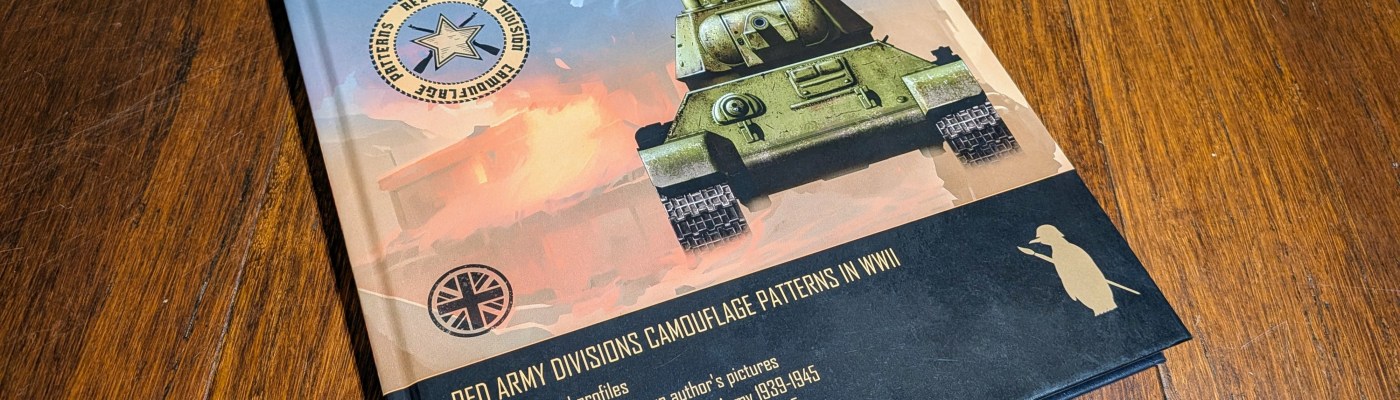
Since mid-2024, freelance military illustrator Igor Donchik has continually self-published a series of books covering vehicle camouflage patterns, tactical markings, and insignia used in World War II. Although there are six books currently available, and four additional volumes in the works, I only have Vol. III – Red Army Divisions Camouflage Patterns in WWII. While I can’t speak to the other works in the collection, Vol. III appears to be an appropriate representation of the series as a whole.
Contents
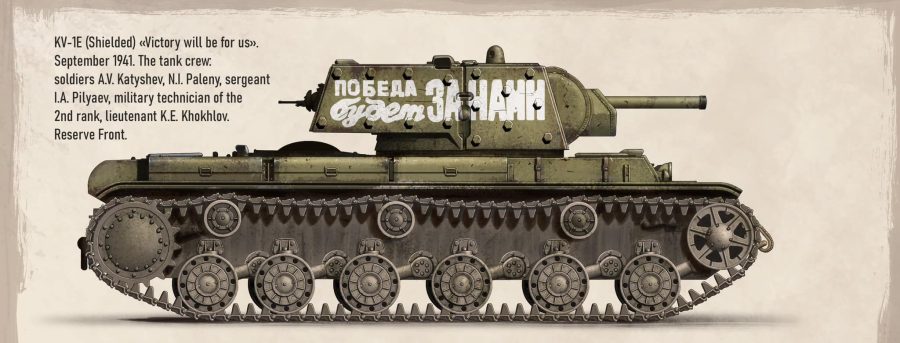
The 128-page book is split into 12 parts. The first five look at Soviet vehicle camouflage by year and season. Parts 6-10 examine specific vehicles (T-26, BA, KV, etc). Part 11 provides some alternate-history designs, and finally, Part 12 is a historical dive into the Battle of Prokhorovka, which took place in July 1943 during the larger Battle of Kursk. All told, there are 180 vehicle profiles, including artwork, tactical markings, and camouflage schemes, for the Red Army (and some German) vehicles from 1938 to 1945.
Camouflage by Year 1938-45 (Parts 1, 2, 3, 4, 5 & 9) – These sections not only showcase a wide range of Soviet camouflage patterns for vehicles and artillery but also detail their development, evolution, and field application. The color plates are not Donchik’s original creations, but faithful recreations of how these patterns were officially applied. Either at the factory or in the field. Each pattern is sourced from a credible reference, such as a manual, book, or historical photograph. It’s an impressive collection that provides insight into how, where, and when each type of camouflage was used. I found the example on p. 32 of a 45mm AT Gun transitioning from summer to winter camouflage especially insightful.
Camouflage by Vehicle (Parts 6, 7, 8, 9 & 10) – This section begins with the T-26 tank, a pre-war design modified throughout the conflict. Donchik includes examples of pre-war paint schemes, field-applied updates, and even captured variants in Finnish and German colors. Next is the BA Armored Car in its many variants. Interestingly, there are more captured German examples than Soviet ones.
Part 8 focuses on the imposing KV series, including the KV-1, KV-1E, KV-85, and a captured German KV-1B. All are presented with summer, winter, and camouflaged paint schemes. Part 10 highlights the T-30 Light Tank and T-40 Amphibious Tank, again showcasing various camouflage styles, including winter whitewash and captured German versions.
Somewhat oddly, Part 9 is not a vehicle-specific section but instead a broad overview of Soviet army units from 1943 to 1945. At 16 pages, it’s the second-longest section in the book and arguably one of the most valuable. It features 37 color plates covering a wide array of vehicles: T-34/76, T-34/85, Studebaker trucks, M3 Scout Cars, Universal Carriers, IS-2s, IS-3s, and SU-122s, many of which include both Soviet and captured German variants. The detailed paint schemes, tactical markings, and tank names provide excellent inspiration for hobbyists.
Alternate History (Part 11) – This brief section includes just six vehicles, but each one is worth a look. These are “what-if” designs and speculative color schemes—vehicles that either never saw service or would have only appeared if the war had continued into the summer of 1945. Notably, while five of the six are Soviet vehicles, all are presented as captured German units.
Battle of Prokhorovka (Part 12) – The final and longest part of the book is a historical overview of the southern sector of the Battle of Kursk. It includes 13 full-color plates, but all of them are German vehicles. Not a single Soviet tank or design is featured. Seems like a perfect time to close out the book with some specific Soviet vehicles that saw action during the battle, but I suppose the previous 10 sections focus on Soviet content.
Overall Impression
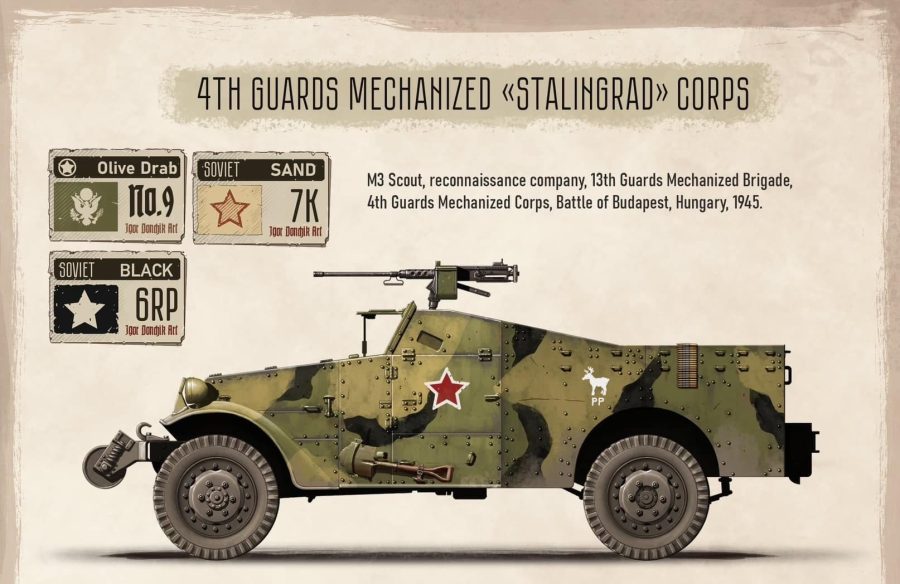
The Artwork – It’s incredible. No other way to say it. The vehicles are rendered in immaculate detail, and the illustrations are brimming with character. Each one is a faithful recreation based on a specific historical source; whether a photo, manual, or training document. Every image is accompanied by background information (sometimes brief, sometimes extensive), which helps place each vehicle in its proper historical context. If you’re buying this book, it’s for the artwork. And rest assured: you won’t be disappointed.
The QR Codes – This is where things get frustrating. A QR code linking to the publisher’s website (not-toys) appears on almost every other page. Not only is this distracting, but scanning it first takes you to a suspicious landing page filled with shady ads before redirecting to the actual store. Do not scan the QR codes. Including one at the beginning and end of the book would’ve been fine. But seeing them repeatedly is a black mark against an otherwise well-designed layout.
Translations – These books were not originally written in English (I believe the originals are in Estonian), the language can occasionally feel convoluted or awkward. All understandable and really not a big deal. But I would be remiss for not mentioning the sometimes confusing syntax throughout.
Final Thoughts
You know those fantastic color plates on Tank Encyclopedia? It’s like having a copy to hold in your hands. As a resource for painting Bolt Action models, the book is unmatched. Instead of scrolling through Google image results, you can flip from page to page in this hardback volume. I think I speak for most hobbyists when I say that it is very much the preferred experience.
The breakdowns of colors and patterns are both intricate and fascinating (although difficult to parse). If you want to paint a Soviet vehicle, this is the book for you. You are spoiled for choice with each highly detailed example providing not only inspiration and direction, but also a specific, exacting background.
Despite my issues with the QR codes (do not scan them), the seemingly never-ending branding by the author, and confusing syntax from time to time, Panzer Camouflage Vol. III: Red Army Divisions Camouflage Patterns in WWII is a valuable resource for any WWII wargaming enthusiast.

 Chicago Dice